| object data | fabric description | archaeometry | petrography |
| sample no | M 154/68 |
|---|---|
| fabric type | PAN-A-1 |
| supposed site of production | Palermo / Panormos |
| sample taken | 2011, by Babette Bechtold, Institute of Fine Arts, New York University |
Context Data |
|
| site of discovery |
Selinunte / Selinus Temple B |
| interpretation of context | sacred |
| registration code of context | Saggio B, US 3, P07.1753 |
| registration code of object | US 3, P07.1753 |
| chronology of context | 310-290 B.C.E. |
Object |
|
| ware | Transport Amphorae |
| object form | Amphora |
| object type | Ramon T-7.1.2.1? |
| chronology of object |
Punic-Late Punic 310-270 B.C.E. |
| fragmentation | shoulder |
| drawing |
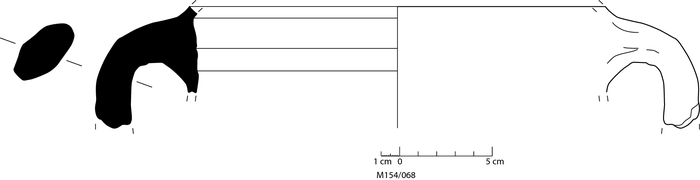
|
| publication | Bechtold (forthcoming), cat. 17. |
| object data | fabric description | archaeometry | petrography |
Visual Examination of Fresh Break |
|
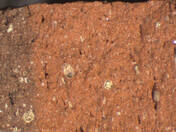
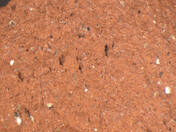
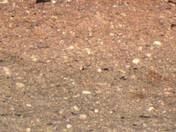
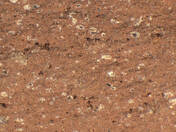
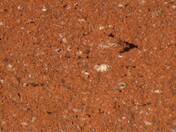
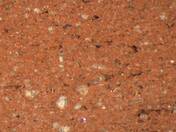
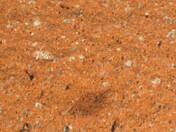
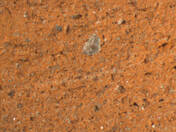
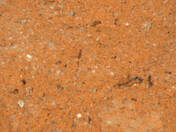
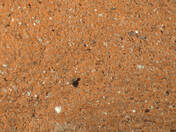
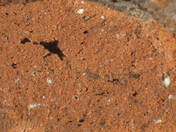
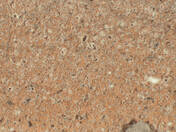
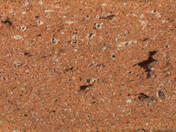
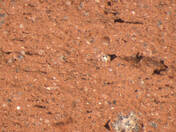
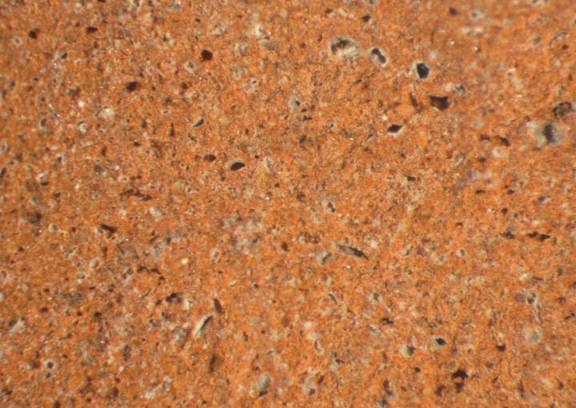
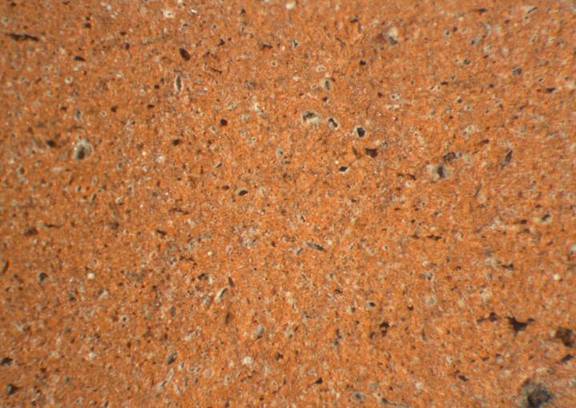
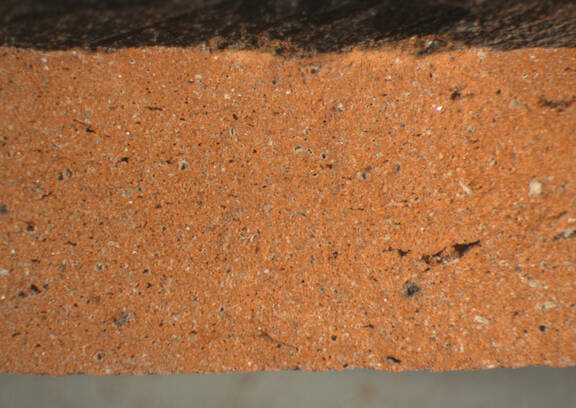
| visual examination of fresh break | colour red, texture fine and compact, numerous small inclusions: white, grey, voids, mica |
| colour of fresh break | red 10 R 5/8 |
| texture of fresh break | smooth |
| hardness | hard |
Observation Under the Binocular Stereoscope(all lengths in mm) |
|
| porosity | 5%; void form: vughy, channel; void length: 0.04 (vughy), 0.06 (channel)-1.0 (vughy), 1.6 (channel) |
| inclusions | 5%, length: <0.04-0.7 |
| sorting | unsorted |
Inclusions(all lengths in mm) |
|
| black inclusions | infrequent, rounded, spherical, elongate, black, <0.04-0.16 |
| calciumcarbonate | very frequent, well rounded - subrounded, very spherical, elongate - subelongate, white, yellowish white, <0.04-0.4 |
| carbonate pseudomorphoses | riddled with, rounded - subrounded, very spherical - subspherical, subelongate, white, yellowish white, <0.04-0.7 |
| mica | frequent, spherical, elongate, angular, white, dark, <0.04-0-12 |
| quartz | very frequent, well rounded - rounded, very spherical - subspherical, subangular, clear, grey, 0.04-0.12 |
| reddish inclusions | very frequent, well rounded - subrounded, very spherical - subspherical, elongate, reddish brown, red, <0.04-0.3 |
| object data | fabric description | archaeometry | petrography |
| applied method for sample analysis | thin section, chemical analysis |
|---|---|
| analysis author | Giuseppe Montana |
| object data | fabric description | archaeometry | petrography |
| sample number | M 154/68 |
|---|---|
| inventory number | Temple B, saggio B, US 3, P07.1753 |
| name of author | Giuseppe Montana - Luciana Randazzo |
| institution of author | Department of Earth and Marine Sciences (DiSTeM) - University of Palermo |
| contact information of author | giuseppe.montana@unipa.it; luciana.randazzo@unipa.it |
Temper Grains |
|
Microstructure |
|
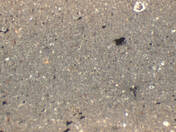
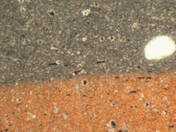
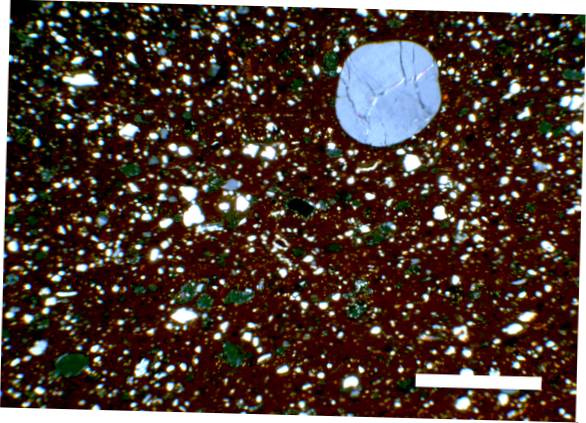
| areal distribution | moderately homogeneous |
| packing (% area) | medium (10-20%) |
| size/granulometry (mm) |
prevalent: very fine (0.04-0.1mm) frequent: fine (0.1-0.2mm) |
| maximum grain size (mm) | 0.6 |
| sorting | good |
| roundness | rounded |
Composition |
|
| minerals |
prevalent: Monocrystalline Quartz common: Polycrystalline Quartz sporadic: Orthoclase, Plagioclase rare: Muscovite |
| other compositional/textural features |
sporadic: Microfossils, Micritic Clots |
| quartz grains | rounded |
Groundmass |
|
Texture |
|
| texture |
moderately homogeneous patchy: rare |
| optical activity | slightly active |
| color (plane polarized light) | brownish |
| degree of sintering | well sintered |
Porosity |
|
| voids/pores abundance (area) | medium (10-30%) |
| voids/pores size |
prevalent: small (0.01-0.1mm) |
| voids/pores orientation | none |
| voids/pores shape |
prevalent: cast |
Newly Formed Phases |
|
| newly formed phases |
rare: secondary calcite |
Clay Composition |
|
| clay composition | ca-rich |
Estimations from Microscopy/Interpretation |
|
Interpretation |
|
| firing temperature | well fired |
| refinement of raw clay | acceptable |
| refinement of temper/clasts | sieved natural sand |
| modelling technique/fabrication | use of wheel |
Distribution of fabric type
“PAN-A-1”
production
discovery
Representative sample for
“PAN-A-1”
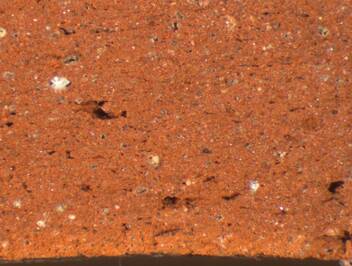
M 107/3
There are 24 more samples assigned to fabric type
“PAN-A-1”.
Other samples assigned to
“PAN-A-1”
M 10/61
M 92/92
M 106/13
M 106/31
M 106/33
M 106/39
M 106/44
M 106/61
M 107/1
M 107/2
M 154/20
M 154/26
M 154/27
M 154/68
M 165/13
M 165/14
M 165/22
M 165/26
M 166/10
M 179/2
M 179/60
M 179/66
M 179/110
M 189/4
Amphorae Production in Punic Sicily: This contribution intends to summarize the status of research on both the typological evo- lution of the Punic Sicilian amphorae series1 and the archaeometric studies available for the known Punic production centers ...…
Amphorae and Coarse Ware Fabrics of Panormos: Evidences for Local Production and Export: Unlike in Motya and Solus, the chrono-typological aspects and the archaeometric features of Panormos' pottery repertoire have still not been studied in detail. Furthermore, to date, we have no information about the localisation of an industrial quarter during the Punic and Roman phase of the site
Anfore e ceramica comune di produzione punica da Entella (PA): IntroduzioneIl presente contributo costituisce una sintesi preliminare dello studio comparato di anfore da trasporto e di ceramica comune punica rinvenuti nell'abitato e in una delle necropoli di Entella
Presenze puniche nella valle dell'Eleuterio. Il caso delle anfore di Monte Porcara (Bagheria, PA): IntroduzioneQuesto piccolo contributo rientra nellinsieme di una serie di studi volti a comprendere i rapporti e le interazioni tra il mondo indigeno, la presenza greca e lelemento punico nellarea del palermitano. Si tratta dunque di una nuova tappa di una ricerca, ancora in itinere, che ha come oggetto lo studio delle dinamiche insediamentali e del popolamento lungo le valli fluviali della Sicilia Occidentale.
Presenze puniche nella valle dell'Eleuterio. Il caso delle anfore di Pizzo Cannita.: Il presente contributo mira ad aggiungere nuovi dati all’iter di studi per la conoscenza della presenza fenicia nel Mediterraneo, volgendo lo sguardo alla Sicilia occidentale, dove l’elemento punico ha attecchito più che altrove nell’isola con la fondazione delle città di Panormo, Mozia e Solunto. Pizzo Cannita (fig. 1) è un piccolo rilievo calcareo (m 208 s.l.m.) di formazione quaternaria immediatamente ad ovest del fiume Eleuterio nel territorio di Misilmeri in provincia di Palermo (I.G.M. F 250 II SO).