FACEM
Provenance Studies on Ancient Pottery in the Mediterranean
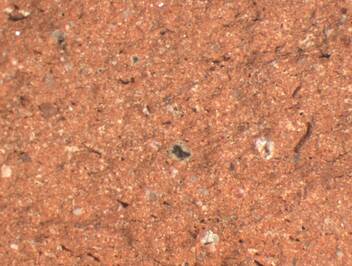
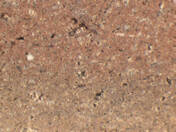
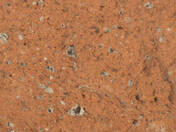
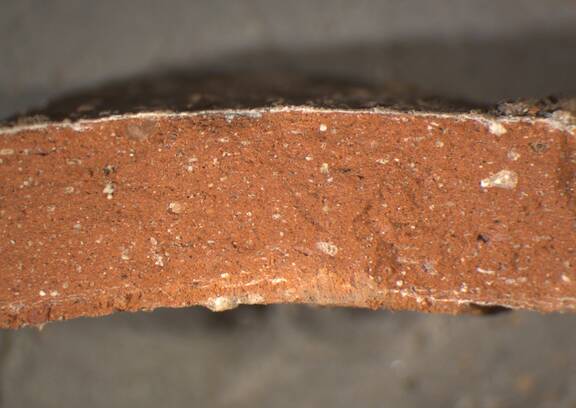
PAN-SOL-A-1, M 106/129, scale bar 0.2mm
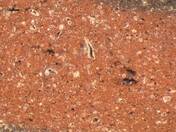
PAN-SOL-A-1, M 106/129, scale bar 0.5mm
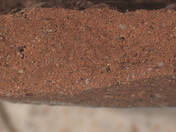
PAN-SOL-A-1, M 106/129, 25x
PAN-SOL-A-1, M 106/129, 16x
PAN-SOL-A-1, M 106/129, 8x
| | object data | | fabric description | | archaeometry | | petrography | | |
| sample no |
M 106/129 |
| fabric type |
PAN-SOL-A-1
|
| supposed site of production |
Palermo/Panormos-Solunto/Solus |
| sample taken |
January 2015, by Babette Bechtold, Institute of Classical Archaeology, Vienna University |
| |
Context Data
|
| site of discovery |
Palermo / Panormos Necropoli |
| interpretation of context |
funerary |
| registration code of context |
PORL T. 10 US 19 |
| registration code of object |
PORL 32 |
| |
Object
|
| ware |
Transport Amphorae |
| object form |
Amphora |
| object type |
Western Greek, Gassner rim 2 |
| chronology of object |
Greek-Late Archaic 510-480 BC |
| fragmentation |
rim |
| dimensions |
diameter: 11cm (rim); height: 5cm |
| surface description |
slipped very pale brown 10 YR 8/3 |
| drawing |
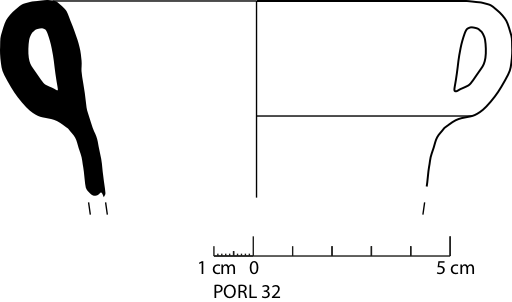
|
| publication |
Bechtold 2015e, 12, fig. 5,2 |
| | object data | | fabric description | | archaeometry | | petrography | | |
| |
Visual Examination of Fresh Break
|
| visual examination of fresh break |
Pinkish reddish clay, compact, with a good amount of white visible inclusions of small or medium size |
| colour of fresh break |
2.5 YR 6/8 |
| texture of fresh break |
granular |
| hardness |
hard |
| |
Observation Under the Binocular Stereoscope
(all lengths in mm)
|
| porosity |
void form: channels;vughy; void length: 0.04-0.56-60 (channel lenght) |
| inclusions |
length: 0.08-0.79; 1.19 (agglomerate) |
| sorting |
bimodal: poorly-sorted sand in well-sorted silt |
| |
Inclusions
(all lengths in mm)
|
|
black inclusions |
rare, rounded, very spherical, black, 0.08 |
|
calciumcarbonate |
frequent, angular;subrounded;well rounded, elongate;subspherical;spherical, white, 0.08-0.79; 1.19 |
|
carbonate pseudomorphoses |
infrequent, subangular, very spherical, whitish/yellowish, 0.04-08-0.12-16 |
|
mica |
infrequent |
|
quartz |
sporadic, well rounded, subspherical;spherical, greyish/transparent, 0.08-0.79 |
| | object data | | fabric description | | archaeometry | | petrography | | |
| applied method for sample analysis |
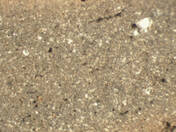
thin section |
| analysis author |
Montana/Randazzo |
| | object data | | fabric description | | archaeometry | | petrography | | |
| sample number |
M 106/129 |
| inventory number |
PORL 32 |
| name of author |
Giuseppe Montana - Luciana Randazzo |
| institution of author |
Department of Earth and Marine Sciences (DiSTeM) - University of Palermo |
| contact information of author |
giuseppe.montana@unipa.it; luciana.randazzo@unipa.it |
| |
Temper Grains
|
| |
Microstructure
|
| areal distribution |
moderately homogeneous |
| packing (% area) |
high (20-30%) |
| size/granulometry (mm) |
prevalent:
very fine (0.04-0.1mm), fine (0.1-0.2mm)
rare:
medium (0.2-0.5mm)
|
| maximum grain size (mm) |
0.4 |
| sorting |
scarce-serial |
| roundness |
angular |
| |
Composition
|
| minerals |
prevalent: Monocrystalline Quartz
sporadic: Polycrystalline Quartz, Orthoclase, Plagioclase, Muscovite, Accessory & Heavy Minerals (Iron oxides)
|
| other compositional/textural features |
prevalent: Microfossils, Micritic Clots
|
| quartz grains |
angular |
| |
Groundmass
|
| |
Texture
|
| texture |
moderately homogeneous patchy: sporadic |
| optical activity |
inactive |
| degree of sintering |
well sintered |
| |
Porosity
|
| voids/pores abundance (area) |
low (<10%) |
| voids/pores size |
prevalent: small (0.01-0.1mm), medium (0.1-1mm)
|
| voids/pores orientation |
none |
| voids/pores shape |
prevalent: irregular, rounded, cast
rare: channels
|
| |
Newly Formed Phases
|
| newly formed phases |
common: secondary calcite
|
| |
Clay Composition
|
| clay composition |
ca-rich |
| |
Estimations from Microscopy/Interpretation
|
| |
Interpretation
|
| firing temperature |
well fired |
| refinement of raw clay |
acceptable |
| refinement of temper/clasts |
sieved natural sand |
| modelling technique/fabrication |
use of wheel |
Cite this page as: FACEM - http://facem.at/m-106-129